If you have ever walked into your bathroom in your socks only to discover a mysterious, unwelcome puddle forming around the base of your toilet, you already know the unique mix of panic and disgust that follows. A toilet leaking at the base is not just a nuisance — it is a ticking time bomb for water damage, subfloor rot, and mold growth that can turn a simple plumbing repair into a very expensive renovation project.
The good news? Most causes of a toilet base leak are well-understood and completely fixable. At Auger Pros Plumbing, we have diagnosed and repaired hundreds of these leaks across the DFW area, and we are here to walk you through exactly what is going on under that toilet and what needs to happen next.
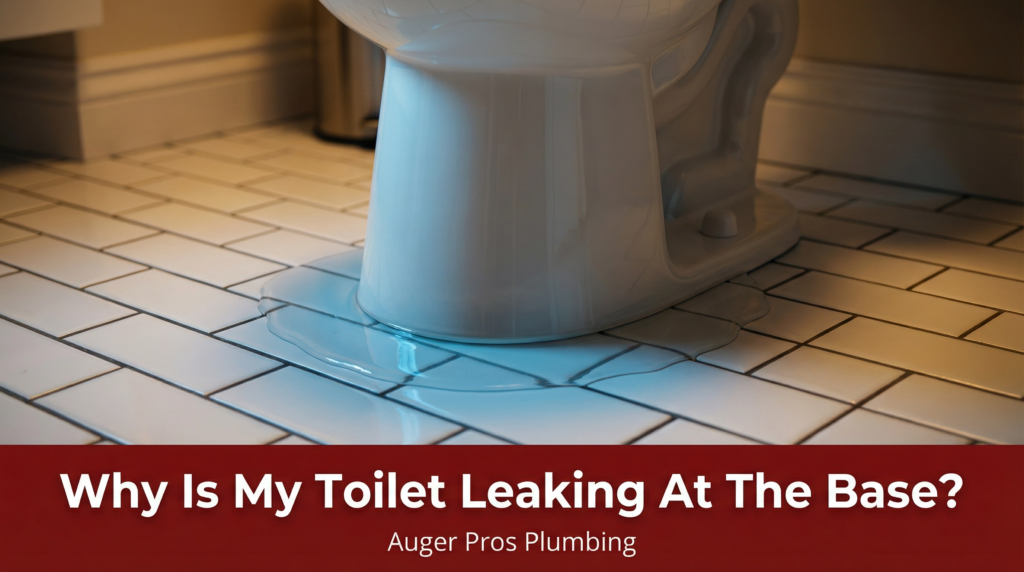
When water appears at the base of your toilet, it means that somewhere between the toilet itself and the drain pipe in your floor, the watertight seal has been compromised. Every flush sends wastewater through that connection, and if it is not sealed properly, water — and everything that comes with it — ends up on your floor.
The tricky part is that not all base leaks are the same. Some appear only after flushing. Some are constant. Some are not even true leaks at all. Identifying the specific cause is the first step toward the right fix.
The wax ring is the most frequent cause of a toilet leaking at the base, and it is the first thing any experienced plumber will check. This ring of pliable wax sits between the bottom of your toilet and the floor flange — the fitting that connects your toilet to the drain pipe. Its one job is to create a completely watertight seal every single time you flush.
Over time, wax rings can dry out, compress, or crumble. If your toilet has ever rocked even slightly, that movement can break the seal prematurely. Once the wax ring fails, every flush sends a small amount of water (and sewage) out onto your floor.
How to identify it: Water appears at the base of the toilet specifically after flushing and then seems to disappear or dry up between uses.
The fix: The toilet must be shut off, drained, unbolted from the floor, and lifted completely off the flange. The old wax is removed, a new wax ring (or modern rubber/silicone alternative) is installed, and the toilet is carefully reseated and re-secured. This is a job that requires precision — if the toilet is not seated perfectly on the new ring, the leak will return.
Look at the base of your toilet. On either side, you will see two plastic caps. Underneath those caps are the tee bolts (also called closet bolts), which anchor the toilet firmly to the floor flange. If these bolts loosen over time, the toilet can develop a slight rock or wobble. That rocking motion is enough to break the wax ring seal and allow water to escape with every flush.
How to identify it: Gently try to rock the toilet from side to side. Even a small amount of movement is a red flag.
The fix: Remove the plastic caps and use a wrench to carefully tighten the bolts. A critical warning here: do not overtighten. Porcelain is strong but brittle, and too much torque on those bolts can crack the base of the toilet, which means you are now buying a new toilet. If tightening the bolts does not stop the movement, the wax ring has likely already been compromised and will need to be replaced.
Not every puddle around the base of your toilet is a true leak. During warm, humid months — or in bathrooms that get heavy steam from hot showers — the cold water inside your toilet tank can cause the porcelain to sweat. Those water droplets run down the outside of the tank and toilet, pooling at the base and looking exactly like a leak.
How to identify it: Thoroughly dry the outside of the toilet with a towel and wait. If water droplets begin to form on the surface of the tank or bowl before any puddle appears on the floor, condensation is your culprit — not a plumbing failure.
The fix: Improve bathroom ventilation by running the exhaust fan consistently during and after showers. In more severe cases, an anti-sweat valve can be installed on the water supply line to slightly warm the water entering the tank, reducing the temperature differential that causes sweating.
While less common than a wax ring failure, a cracked toilet bowl can absolutely cause water to pool at the base. Hairline cracks can develop from age, manufacturing defects, or — again — from someone overtightening the tee bolts. These cracks are often nearly invisible to the naked eye.
How to identify it: Inspect the base of the toilet very carefully with a flashlight. If water is pooling even when the toilet has not been recently flushed, a crack is a strong possibility. You may also notice a constant, slow drip rather than the flush-triggered leak pattern of a wax ring failure.
The fix: Porcelain cannot be reliably repaired. A cracked toilet bowl means the toilet needs to be replaced entirely. The silver lining? Modern toilets are significantly more water-efficient than older models, so a replacement often pays for itself over time in reduced water bills.
The water supply line is the flexible hose that runs from the shutoff valve on your wall or floor to the bottom of the toilet tank. If the connections at either end become loose, or if the hose itself develops a crack or pinhole, water can drip down the back of the toilet and pool at the base — making it look like a base leak when the actual source is higher up.
How to identify it: Run your hand along the entire length of the supply line and feel the connection points at both ends. If anything feels wet or damp, you have found your source.
The fix: Try gently tightening the compression nuts at each connection with a wrench. If the hose itself is cracked or corroded, it is an inexpensive part to replace and a straightforward repair.
| Symptom | Most Likely Cause |
| Water appears only after flushing | Failed wax ring |
| Toilet rocks or wobbles | Loose tee bolts |
| Water droplets on tank/bowl exterior | Condensation |
| Constant slow pooling, no flush needed | Cracked bowl or base |
| Wet supply line or connections | Leaking supply line |
A toilet leaking at the base might seem like a minor inconvenience, but the damage it can cause is anything but minor. Water that repeatedly seeps under the toilet will saturate the subfloor, leading to rot, structural damage, and mold growth — all of which are far more expensive to remediate than a simple wax ring replacement. Sewage-contaminated water also poses a real health risk to your household.
If you notice any pooling around your toilet base, the right move is to act quickly. Turn off the water supply to the toilet using the shutoff valve on the wall, and call a licensed plumber to diagnose the issue properly.
Some of the fixes above — like tightening a supply line connection — are genuinely within reach for a confident homeowner. But replacing a wax ring, reseating a toilet, or replacing a cracked toilet bowl requires the right tools, the right technique, and the experience to do it correctly the first time. A poorly seated toilet on a new wax ring will leak just as badly as the old one.
At Auger Pros Plumbing, our licensed technicians diagnose toilet base leaks accurately and fix them permanently. We serve homeowners across the DFW area Monday through Saturday, and estimates are always free. We also offer financing through Synchrony, including 6 months at 0% interest, so an unexpected plumbing repair does not have to derail your budget.
Do not let a small leak become a big problem. Call Auger Pros Plumbing today and let us take care of it the right way.
Is a toilet leaking at the base an emergency?
It depends on the severity. A slow drip is not an immediate emergency, but it should be addressed within a day or two to prevent subfloor damage. If water is flowing freely or you smell sewage, treat it as urgent and call a plumber right away.
Can I fix a toilet base leak myself?
Tightening tee bolts or a supply line is a reasonable DIY task. Replacing a wax ring is more involved — it requires disconnecting the water supply, draining the toilet, unbolting and lifting the toilet, and reseating it precisely. Many homeowners attempt this and end up calling a plumber anyway after an imperfect seal causes the leak to continue.
Why does my toilet only leak sometimes?
An intermittent leak that appears only after flushing is the classic sign of a failed or failing wax ring. The wax is no longer creating a complete seal, so water escapes under pressure during a flush but the area dries up between uses.
Auger Pros Plumbing serves the DFW area with professional residential and commercial plumbing services. Financing is available. Call us today.